

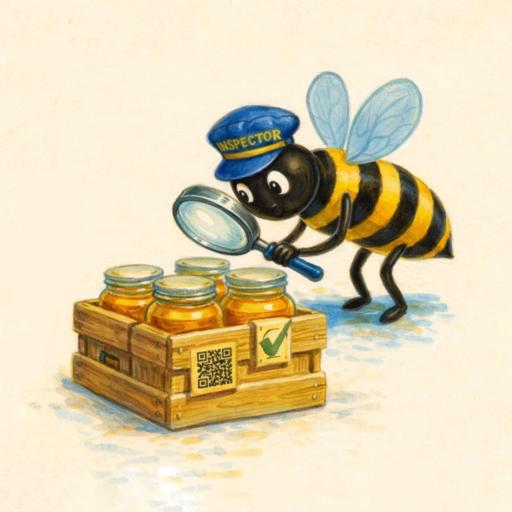
“Trust me” has never been a particularly strong foundation for global trade. For most of history, we relied on paper records, intermediaries, and reputation to bridge the gap between producers and buyers who would never meet. Sometimes it worked. Often it didn’t. Our story began in a forest. In Zambia, beekeepers hung hives high in the canopy, not as a romantic tradition, but as a practical way to earn income while keeping trees standing. Honey became a counterweight to extraction. It provided proof that value could flow from the old-growth forest without destroying it. That was the first lesson: regeneration is possible… especially if it works economically.
The second lesson was harder. Even when a product is produced responsibly, trust does not automatically follow. African honey, despite unique quality and consumer demand, has been locked out of premium markets by fraud committed elsewhere in the Paper certificates and good intentions prove fragile; blockchain builders are writing the next chapters on immutable pages. supply chain.
Third lesson: Governments are no longer tolerating opacity. Regulations like the EU Deforestation Regulation and the Digital Product Passport are not symbolic gestures; they carry deadlines, penalties, and real consequences. For the first time, global supply chains are being required to prove what they claim. The dreamy ideas about what blockchain can do could turn out to be practical, cost-effective solutions to global problems.
When traceability becomes infrastructure - when data is captured at the source, verified, and made durable - it turns out not to be the end of the story, but the foundation of what comes next. What will come after traceability?
From Records to Financial Identity
Millions of producers around the world are excluded from modern financial systems. This is especially true in very rural areas and developing nations. Their exclusion has little to do with productivity or even trustworthiness. It has everything to do with proof. Crops are sold for cash. Payments are informal. Records are thin or nonexistent. Without documentation, there is no income history. Without income history, there is no credit, insurance, or financing. Without credit or financing, producers can’t really improve their systems or acquire new land or better equipment. Without insurance, they are one dry season away from ruin.
Traceability begins to change this by recording reality.
When production volumes, quality checks, and payments are captured as part of a traceable supply chain, those records accumulate into something new: a verifiable financial identity. Not just a credit score based on some centralized, developed-world service provider, but a history grounded in real work, real deliveries, and real outcomes.
Over time, that identity can unlock loans, insurance products, and performance-based financing. Risk can be assessed using evidence rather than assumptions. Farmers and co-ops that were once invisible to formal finance become legible.
This is financial inclusion driven not by foreign aid, government capacity, or special programs, but by proof.
From Traceability to Tokenization
Once commodities are traceable, the next step follows naturally: representation. Traceability data can feed into proof-of-reserves, confirming that a physical asset exists, in a specific quantity, in a documented location. That verified state can then be represented on-chain as a token, backed one-to-one by real material value.
Blockchain degens and cynical observers might think of “tokens” merely as speculative vehicles. This is not that. This is tokenization as infrastructure.
A tokenized commodity can move more efficiently through markets than a wheelbarrow full of wheat can. A token can be used as collateral. It can be integrated into traditional financing structures without ever severing its link to the physical asset it represents. The distinction matters. These are not digital assets tied to social media fads. They represent a verified reality.
Without traceability, tokenization is fiction. With it, tokenization becomes credible.
The Oracle Layer: Making History Machine-Readable
Behind the curtain of this fascinating future is an important question: how do real-world facts enter a digital ledger?
Like a human brain that needs input from the body to understand the world around it, an asset ledger needs its own eyes and ears. In asset systems, this sensing organ is called an oracle. In simple oracles, a single data point is pushed on-chain to represent a moment in time: a price update, a delivery status, a certification flag. These inputs are useful, but limited. They capture outcomes, not context.
Traceability systems allow a broader approach. Instead of just endpoints, they record many real-world events over time, like harvests, inspections, movements, processing steps, and payments. The focus shifts from “what is true right now?” to “what has happened to it?” This enables continuous audit trails rather than one-off checks, and more accurate risk assessments.
In effect, the oracle layer becomes a way to compress a commodity’s history into a single, verifiable reference. It’s something that can be checked, shared, and built upon in new ways.
When Verification Reaches the Consumer
Not all of these changes remain behind the scenes. At the consumer level, traceability enables the rise of verified marketplaces—places where products can be scanned and traced back to their source as a matter of course, not novelty. Platforms like Palmyra Express offer early glimpses of this future, where olive oil, tea, or honey arrives with proof attached.
Over time, “verifiable” begins to function like a category. But rather than competing with other buzzwords like “organic” or “sustainable”, this buzzword is actually a new layer that can give those old ones more meaning than they ever had before!
Just as “organic” reshaped grocery aisles in the early 2000s, verification may reshape them in the 2030s. Consumers learn to scan first and buy second. Producers who can demonstrate good practices earn trust—and often better prices. Transparency creates its own feedback loop.
The Hard Questions: Standards and Governance
None of this is automatic or guaranteed. If every regulation, platform, or industry defines traceability differently, the result will be fragmentation—duplicated effort, incompatible systems, and new forms of exclusion. Standards matter. Interoperability matters. Governance matters.
Who decides what data is required? Who controls updates or corrections? Who benefits from visibility, and who bears the burden of compliance?
Efforts like Digital Product Passport working groups and emerging DAOs or cooperative-based governance models are early attempts to answer these questions. They are not glamorous, but they are essential if verification is to scale.
Leapfrogging the Old World
There is a paradox at the heart of this transition. Wealthy economies are weighed down by legacy systems. Big behemoths are resistant to change. Emerging economies have far less infrastructure to replace.
That absence becomes an advantage. In places like Zambia, Nigeria, or Bangladesh, traceability is being adopted not as a retrofit, but as a default. Digital proof comes first. The future of global trade may be shaped not in traditional centers of power, but in rural supply chains that adopt verification from the ground up.
A New Social Contract for Trade
When everything becomes verifiable, power shifts. Producers gain leverage because they can prove their value. Consumers gain visibility because they can see beyond labels. Buyers gain confidence because risk becomes measurable.
Opaque supply chains have caused problems for millennia, and all the solutions we tried had their limits. Wrinkled papers, distant filing cabinets, conflicting incentives, and outright fraud muddied the waters at every turn. Even digital databases alone could not crack this old nut. Blockchain is a new technology tool that allows us to capture the truth in new ways, and build new stories and new futures based on proof.
A jar of honey from a forest in Zambia is already telling its truth. Tomorrow, maybe everything else will too.
No comments yet…