

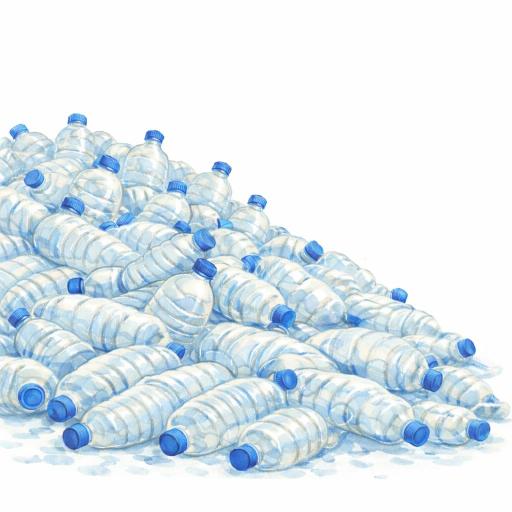
How’s this for an inconvenient truth: New plastic is cheaper than recycled plastic.
This little detail explains more about the plastic problem than most marketing or sustainability campaigns ever do. If you are in business and have a product or a package made of plastic, how are you choosing your supplier? If cost is a deciding factor (and it always is) recycled plastic doesn’t even get an audition.
It’s not a moral failure. It’s a market one.
Recycled plastic has unique cost contributors: collection, sorting, verification, and processing. New plastic benefits from established supply chains and well-established major scale. Ultimately, it means that a freshly molded virgin plastic bottle costs less to make. Regardless of how sincere corporate commitments or consumer ideals might be, market realities mean that sustainable plastic has a steep hill to climb. Understanding this economic reality is the first step toward fixing it.
Come closer, my PET
PET (Polyethylene Terephthalate) is a strong, clear, lightweight plastic. It is widely used for food packaging, drink bottles, and clothing fibers because it’s durable and food-safe. It’s also highly recyclable - hypothetically, anyway. This is the particular plastic we’re talking about today.
Using recycled PET plastic does reduce its environmental impact. Producing recycled PET (often called rPET) requires less energy than producing brand-new PET. Unfortunately, energy savings and environmental benefits don’t automatically translate into competitive pricing. Someone has to pay for recovering the plastic after you used it. Someone has to transport it, sort it, and then actually sell it back into production somewhere. Those costs don’t disappear just because we want to “do the right thing.”
This creates a familiar gap: good intentions without aligned incentives. Without funding mechanisms or regulatory pressure, sustainability commitments struggle to survive contact with procurement spreadsheets. Closing that gap requires systems that don’t just encourage better choices, but justifies them economically.
From Gold Stars to Guardrails
As a child of the 80s, Reduce, ReUse, Recycle was the pledge of my grade-school classroom. We thought it was all up to us as little individuals. Forty years later, we grade schoolers have grown up, and are sitting in seats of leadership around the world. Sustainability is finally moving beyond voluntary commitments in elementary classrooms and into the realm of regulation and compliance.
Extended Producer Responsibility (EPR) frameworks and the EU’s Corporate Sustainability Reporting Directive (CSRD) are two examples. These new regulations compel companies to do more than report on recycling targets. They must provide supporting evidence of who recovered the material, where, and how much.
These regulatory demands expose the limits of traditional reporting. Annual audits and reports provide snapshots. But they are slow and costly to produce, and poorly suited to answering detailed follow-up questions from regulators, investors, or the public. In this environment, sustainability is a millstone around the neck of enterprise. Slowing down economic engines isn’t the outcome we are after, so what’s the solution?
Plastiks.io Masterclass at the Cardano Summit 2025 in Berlin
This tension sizzled in the air at the Cardano Summit 2025 in Berlin. Across keynotes, booth presentations, and side conversations, these themes surfaced again and again: transparency, trust, sustainability. At one Masterclass session, we got a peek at how one company is taking a crack at the problem.
In that session, André Vanyi-Robin, Founder and CEO of Plastiks.io, described a pattern he has encountered repeatedly while working with large consumer brands: sustainability commitments collide with procurement economics and regulatory scrutiny long before they are exposed to public opinion. The project he presented, called RENUEVA, offers an example of how that collision can be resolved.
Receipts Please
Danone is a global food and beverage giant. While the parent company might just ring a bell, you are definitely familiar with many of their popular products, which include Evian water, International Delight creamers, and many local brands. Just to state the very obvious: this is a big player in plastic bottles. Ergo, Danone will play some notable role in regulatory efforts to change the plastic bottle paradigm.
So in Spain, Danone partnered with a plastics recovery organization called Trinijove, and a blockchain data verification service, Plastiks.io. The goal is to meet regulatory compliance demands with a traceable recovery model for PET bottles.
The project roles are simple:
- Danone funds the recovery effort
- Trinijove performs on-the-ground collection
- Plastiks.io verifies each step and transforms recovery actions into auditable data
Every kilogram recovered is accompanied by real-world documentation: invoices, transport records, proof of payment. Together, these establish what was collected, where it moved, and where it went. Some of that information is anchored on-chain as tamper-evident proofs. The underlying documentation remains off-chain but accessible when needed, preserving privacy while ensuring accountability. The result is plastic recovery accompanied by evidence that can survive audits, scrutiny, and time.
Why it matters
Without traceability, sustainability claims leave companies exposed to accusations of greenwashing, fines, consumer backlash, stakeholder doubt, regulatory gaps. The idea of a greener future has broad appeal and support, but without the ability to verify green actions, the problems simply outnumber the solutions.
It matters to Danone
Danone has lots of reasons to want this to succeed, and behind every reason is a stack of dollar bills. It’s not dreamy idealism, but dollars in the right places mean incentive alignment. For this project that means a few things. First, regulatory readiness: CSRD and EPR compliance will be made easier - AND CHEAPER. Next, investors will have greater trust when they can see those ESG requirements being met in a reliable, verifiable way. Finally, it’s a customer credibility win, because transparency protects against accusations of greenwashing.
Broader impact
By integrating with Plastiks.io, the Renueva project is becoming a model of corporate accountability in Europe. It is a proof-of-concept for how global brands can scale verified circularity. Success in this project will open doors for more exciting stories of sustainability that makes market sense in the future.
Conclusion
The RENUEVA project shows that sustainability doesn’t fail because people don’t care. It fails when systems can’t support proof, accountability, and economic reality at the same time. Traceability doesn’t make recycled plastic cheaper by itself. But it creates the foundation for trust, regulation, and incentive mechanisms that can close that gap. But there is still an unavoidable question. We might agree that traceability is the key to sustainability that makes sense. And sure, it’s fine that they are using Cardano if that’s what they want to do. But couldn’t they do the same thing with a good old fashioned database? Stay tuned for the next article in this series, where we will tackle this question. We will show that blockchain itself is actually the fulcrum - the new “simple machine” - that makes this revolutionary work possible.
No comments yet…