

##Why not just use a database?
Centralized systems can store information, but they struggle with something regulators and enterprises care deeply about: record continuity.
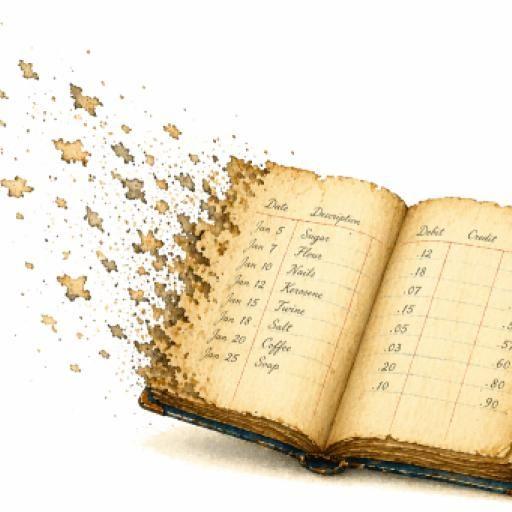
Sustainability programs are long-lived. Governments and large enterprises want to track and prove sustainability improvements across decades. Goals may be set that only our children will live to see fulfilled. Meanwhile, recovery partners change over time. Many different partners may participate in a single large effort. Vendors may disappear after a year or a single short decade. Technology evolves. Systems migrate.
The year is 2035 — do you know where your data is?
Centralized databases introduce another challenge as well: ownership. When sustainability data lives inside one organization’s system, every other stakeholder - regulators, auditors, investors, NGOs - must trust that organization to preserve, maintain, and present the record accurately and indefinitely. That trust requirement grows heavier as the number of participants increases and incentives diverge.
A critical role for blockchain
Blockchain contributes a narrow but important capability: it preserves critical proofs independently of any single organization.
Once a recovery event is recorded, it remains verifiable even when the original platform, provider, or administrator no longer exists. This independence matters precisely because sustainability systems must outlive vendors, reporting cycles, political administrations, and even the companies that helped stand them up.
In the RENUEVA project, Cardano provides independent timestamping and immutable audit trails that regulators and auditors can verify directly, without relying on Plastiks.io, Danone, or any other single party to remain in business.
Just as important as what happened is when it happened. Blockchain provides cryptographic timestamping that proves recovery events occurred at a specific moment in time. They can not be retroactively inserted later or fixed up for an audit. They are anchored on when the action actually took place.
This also functions as a form of vendor-exit insurance. If a platform provider disappears, is acquired, or pivots away, the underlying proofs remain independently verifiable. Sustainability records don’t vanish with the company that helped generate them.
Shared truth without a single referee
Plastic recovery ecosystems involve many actors with misaligned incentives: brands seeking compliance at the lowest cost, recovery organizations seeking stable funding to keep working, auditors seeking defensible evidence, regulators seeking neutrality, and the public seeking credibility.
In traditional systems, audits often become reconciliation exercises: comparing multiple records to determine which version of events is “correct.” Blockchain removes that complexity by allowing all stakeholders to verify the same underlying proofs, rather than negotiating between competing datasets. The goal isn’t to ignore trust, but to reduce the trust surface - minimizing the number of actors who must be trusted for data integrity to hold.
Selective disclosure mechanisms ensure that regulators can verify facts without exposing sensitive commercial data. What becomes public is just the PROOF, without exposing pricing models, supplier contracts, or proprietary volumes. Transparency is achieved without forcing companies to reveal information they cannot afford to make public.
Notably, blockchain (and Cardano) operates in the background. Vendors upload proofs through familiar web interfaces. Auditors interact with dashboards, not wallets. The blockchain-anchored technology exists to support trust, not to demand attention.
When doing better costs less
Traceability itself does nothing to close the price gap between new and recycled plastic. But it enables tools that can.
Verified recovery data can be used to issue Plastic Credits, where each credit represents a documented unit of additional plastic recovery tied to measurable environmental or social impact. It also enables Carbon Avoidance Credits. By proving that recycled plastic was used instead of virgin plastic, manufacturers can account for avoided emissions, enabling access to funding that helps offset the higher cost of recycled materials.
Perhaps most importantly, once recovery events are independently verifiable, they can be reused. New regulations, incentive programs, or reporting frameworks can be layered on later, without recollecting data or rerunning recovery efforts.
Without proof, ideas like this wouldn’t be worth the napkin they’re sketched on. With proof, there is something real that can be leveraged for good through incentives that make sense. At scale, even relatively modest per-ton incentives can change procurement decisions. What was once an environmental compromise becomes an economically defensible choice.
Conclusion
The most important outcome of this model isn’t a token, a credit, or a dashboard. It’s a shift in what we can expect from sustainability systems.
Public, verifiable data replaces self-reported claims. Continuous verification replaces annual snapshots. Sustainability reporting becomes something that can be inspected, not merely believed or dismissed.
That matters not only for Danone, but for regulators, investors, and communities who increasingly expect environmental commitments to be backed by evidence. As more countries adopt EPR frameworks and anti-greenwashing rules, projects like RENUEVA point toward a future where sustainability infrastructure is built for accountability from day one.
The defining question is no longer whether companies make sustainability promises, but whether they can prove them.
No comments yet…