

Trust is the invisible ingredient in every package of food you pick up. The package says it’s “pure” “organic” “ethical” or “fresh”…but is it? How do you know? Does it matter?
In recent years, food-fraud experts have warned that some of the world’s most beloved foods are also among the most adulterated. Studies have shown repeatedly that 30-50% of the jars of honey on grocery shelves are contaminated or inauthentic. Olive oil is famously counterfeited; “extra virgin” often isn’t. Tea and coffee are routinely bulked with fillers, mislabeled, or blended in ways that obscure their true identity. Beyond food: minerals, metals and other raw materials suffer in purity, quality and usefulness, due to opaque sourcing and unverifiable claims.
The problem isn’t just what ends up on the shelf. It’s that we don’t have dependable ways to verify exactly what it is, or how it got there.
For decades, supply chains have relied on paper documents, siloed databases, and unverifiable certifications. In a system this fragmented, fraud isn’t an anomaly, it’s an inevitability. And honest producers, especially in emerging markets, are the ones who pay the highest price. (not to mention the downstream effects on consumers!)
This introduction to the problems in the supply chain traceability landscape emerged during a breakout masterclass at Cardano Summit 2025 in Berlin, led by Thomas Staubli and Sam Lambert of ZenGate Global, the team behind the Palmyra traceability platform. Their session laid out how real-world supply chains can move beyond paper promises toward verifiable digital proof, and where the Palmyra platform fits in.
“Trust has become the most counterfeited ingredient in global supply chains.”
That is the backdrop against which a new story is emerging. It starts in the buzzing forests of Zambia, and in the honey processing facilities of Lusaka, and among a growing network of food producers around the world who are learning how to prove what they’ve known all along: their products are real, authentic, and responsibly made.
It’s also a story about how traceability is shifting from a “nice-to-have” to a non-negotiable requirement for global trade, and how digital proof systems built on the Cardano blockchain are preparing to play a leading role.
The Regulatory Wave: Why Transparency Is Now Mandatory
For years, traceability was talked about as a goal, or an ideal. It was viewed as something admirable, but not required - or even entirely achievable. But that era is ending. A new generation of government regulations is reshaping global markets, and they all share one feature: they demand verifiable proof.
EU Deforestation Regulation (EUDR)
Adopted in 2023, the EUDR requires exporters of cocoa, coffee, timber, soy, rubber, palm oil, cattle, and derived products to provide farm-level geolocation, time-stamped evidence of production, and proof that no deforestation occurred after December 2020. It goes into full enforcement for medium and large enterprises on 30 December 2025, and for small businesses by June 2026.
Under this law, failing to prove compliance doesn’t just risk a fine—it can result in being barred from the EU market entirely.
EU Digital Product Passport (DPP)
Rolling out across product categories, the DPP requires that physical goods entering the EU carry a digital passport documenting origin, composition, sustainability data, and chain-of-custody history. These aren’t marketing gloss—they are mandatory disclosure frameworks aimed at combating greenwashing and fraud.
FDA Food Traceability Rule (FSMA 204, USA)
By 2028, the United States will require higher-risk food categories to maintain detailed, digital records of their movement through the supply chain. Recordkeeping must respond to auditor requests within 24 hours.
Across all these frameworks, the theme is the same: Proof or no market.
A Turning Point in Understanding the Stakes
I’ll be candid: I didn’t always understand why traceability mattered so much. Even as I understood that food fraud and greenwashing is a concern, I still doubted that consumer demand alone would force any real change. As a shopper, I might like the idea of verified origin or sustainable sourcing, but in the grocery aisle, I - like most people - often just grab the honey bear that seems “good enough,” at a price I want to pay.
I believed transparency was a nice marketing angle – but it was optional, not transformative.
The “AHA!” moment for me was understanding that this new wave of government regulations is arriving with real reach, real enforcement, real deadlines, and real consequences.
Not guidelines. Not pilot programs. Laws.
These frameworks don’t just encourage better behavior, they mandate verifiable data that can withstand audits and legal scrutiny. Access to the world’s biggest markets will depend on a producer’s ability to supply transparent, digital, auditable records.
Suddenly, blockchain-enabled traceability isn’t hypothetical or idealistic. It is a practical, cost-effective solution to a very real compliance challenge.
That realization reframed everything for me! The idea isn’t that the future of global supply chains will be shaped by consumer preferences. It will be shaped by regulation, compliance, and proof.
A New Architecture of Trust: The Palmyra Traceability Stack
To meet this moment, producers need a system designed for more than marketing. They need proof infrastructure: tools that make compliance both feasible and affordable.
Enter Palmyra, a trace-and-trade platform developed by ZenGate Global. The name nods to ancient Palmyra in Syria, a legendary crossroads city on the Silk Road, where East-West commerce once depended on safe passage and trustworthy exchange. In a modern echo of that role, today’s Palmyra aims to provide the digital infrastructure that lets producers and buyers connect with transparency and confidence.
Palmyra is built to empower emerging markets, where paperwork is unreliable, connectivity is unstable, and trust gaps run deep. They offer a one-stop platform for recording data, verifying identity, anchoring information on-chain, and facilitating compliant trade.
Here’s how it works.
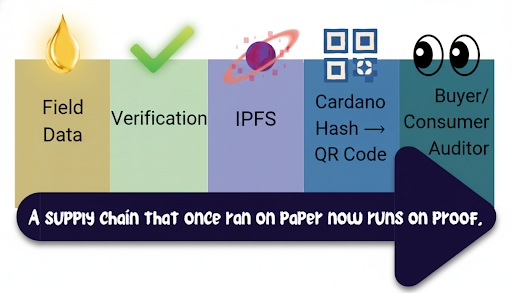
1. Data Capture: The Reality of the Field
Farmers and field staff use an offline-first mobile app to record:
- hive or farm geolocation
- harvest dates and volumes
- fermentation or processing steps (for crops like cacao)
- timestamped photos or videos
- quality indicators
- chain-of-custody transitions
This data can be collected even without internet access, then synced when a connection becomes available.
“You can’t collect data in the field if your system doesn’t work in the field.” -Sam Lambert, ZenGate Global
2. Verification: Who Submitted This, and Where?
Using an open-source module called “Winter Protocol,” Palmyra checks:
- identity: biometric or credential match
- location: GPS consistency (e.g., Zambian honey can’t be logged from Japan)
- legitimacy: manager approvals, role-based permissions
- optionally: IoT devices or AI agents can verify additional data streams
This builds a chain of accountability around each data point.
“Before data becomes immutable, we verify who collected it and where they were.”
3. Storage: IPFS as the Truth Container
Raw data is packaged into a structured digital record and uploaded to IPFS, a decentralized content-storage network. IPFS returns a Content Identifier (CID), a unique fingerprint of the data.
4. Immutability - Anchoring on Cardano
The CID is then hashed onto the Cardano blockchain using the Winter Protocol. This creates a permanent, tamper-evident record that publicly proves:
- This data existed
- In this exact form
- At this exact time
With near-perfect uptime, low transaction fees, and a strong reputation among enterprises and NGOs, Cardano is uniquely well-suited for global traceability at scale.
“We don’t certify — we record. Every record has a traceable story attached.”
What Changes When Supply Chains Become Verifiable?
The shift from paper promises to digital proof reshapes the lives and incentives of everyone involved in a supply chain. This isn’t abstract “tech impact”—it shows up in the daily realities of farmers, cooperatives, regulators, buyers, and even the shoppers comparing jars on a grocery shelf.
For farmers
Verifiable data becomes a kind of economic passport. Each purchase, each bucket of honey sold, each delivery logged in the system creates a transparent payment record that cannot be altered or lost. Over time, these entries form a verifiable income history - that’s something many rural producers in developing countries have never been able to provide to a bank or insurer. Proof of good practices, clean harvests, and consistent production becomes leverage: farmers can demonstrate compliance, negotiate better terms, and participate more fully in financial systems that once excluded them.
For Co-ops
Cooperatives gain a different kind of visibility. Instead of scattered notebooks and reports, they see their operation as a living map: hives or farms pinned across a landscape, each with associated records, harvest logs, and quality data. Batch management moves from guesswork to a structured, traceable workflow. Fraud and misreporting—whether accidental or intentional—are harder to conceal when every step has a timestamp and a signature. And because Palmyra is built for offline regions, field teams can coordinate in rural, low-connectivity environments without losing data or momentum.
For Global Markets
Governments and regulators benefit in ways that directly address the global push for environmental accountability. Farm-level geodata, once nearly impossible to gather at scale, becomes standard. Real-time auditability allows agencies to verify claims tied to laws like the EU Deforestation Regulation without relying solely on paperwork or inspections. Instead of reacting to environmental harm, governments gain tools to monitor land-use change as it happens, helping them reward compliant producers while identifying and intervening in areas at risk.
Buyers (importers, retailers, brands) gain something equally valuable: confidence. Claims such as “organic,” “single-origin,” or “forest-friendly” can now be linked to verifiable data trails rather than marketing language. That reduces regulatory exposure, strengthens ESG reporting, and builds trust with customers who increasingly want to know not only what they’re buying, but where it comes from and under what conditions it was produced.
For you
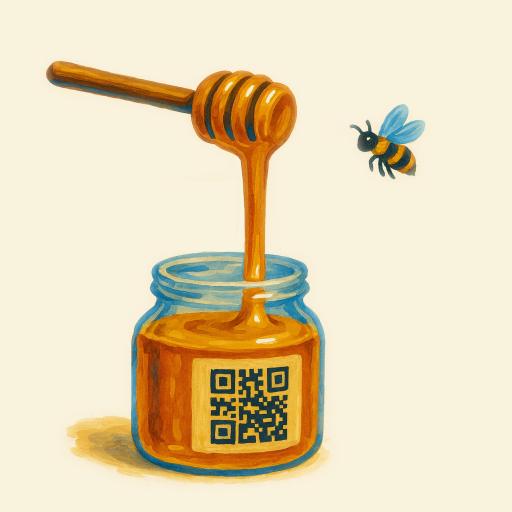
For consumers, the final step of the chain, the experience becomes surprisingly intimate. A simple QR code on a jar of honey becomes a window into its journey:
- Where was it harvested?
- Which beekeeper tended it?
- When was it processed?
- What is the deforestation profile of the region where the hive was placed?
Any kid who ever sat and ate their cereal while reading the back of the box can tell you how compelling a good package can be. Now adults too can enjoy a good product story - one that comes with grown-up, non-fiction proof!
“When a buyer can see exactly where a product came from — the hive, the farmer, the coordinates — trust becomes visible.”
In a world where fraud has become commonplace, proof becomes its own kind of luxury. And for the first time, it’s available to everyone along the chain—not just the certifiers who used to hold the keys to credibility.
Nature’s Nectar Zambia: A Prototype for the World
Nature’s Nectar already maintains nearly 30,000 geotagged hives across Zambia, working with about 3,000 small-scale beekeepers. Their long-standing practice of mapping hive locations made them a perfect early partner for Palmyra. With help from the University of Amsterdam, satellite analysis confirmed zero deforestation in the areas where their hives operate: a powerful, data-driven validation of the regenerative model they have championed for years.
And in the coming months, their honey will appear on shelves in the United States and Canada via Palmyra Express, complete with on-chain traceability. https://www.palmyra.express/us/store
The Shift: Traceability as Infrastructure
What we’re seeing is not a marketing fad. It is a structural realignment of how global trade works. Transparency increases earnings, improves compliance, reduces fraud, and gives smallholders tools they’ve never had before. Emerging markets, which lack entrenched legacy systems, are poised to leapfrog straight into next-generation supply-chain infrastructure. Traceability doesn’t just rebuild trust, it rebuilds opportunity.
Conclusion
Supply chain trust was once a matter of certificates, relationships, labels, self-reported claims, and the hopeful assumption that everyone along the chain told the truth.
But people and paper can be dishonest. Access and opportunity can get disconnected.
In this context, an immutable public ledger could change the world. Now, a jar of honey harvested in a quiet Zambian forest can carry a story that is not just told, but proven.
No comments yet…